
Schema & Stability
This page documents the machine-readable contract for the JSON and Graphify formats. If you’re building tooling on top of GraphScribe (or feeding exports to an AI agent), this is what you need to know. If you just want to read exports, you can skip this page.
Version stamps
Section titled “Version stamps”Every JSON and Graphify document carries identity fields at its root:
| Field | Value | Where | Meaning |
|---|---|---|---|
generator | "GraphScribe" | JSON + Graphify | Producer name |
generatorVersion | "1.1.0" | JSON + Graphify | Plugin version (kept in sync with VersionName in GraphScribe.uplugin) |
schemaVersion | 1 | JSON root | Shape of the EmitJson IR (variables/nodes/edges/diagnostics/…) |
schemaVersion | 2 | Graphify root | Shape of EmitGraphify + merge linkage (v2 adds evt: event nodes) |
dumpMode | full / modifiedOnly / blueprintOnly | JSON + Graphify root | Optional property dump mode used for this document (settings) |
dumpMode is stamped on per-asset documents only. The merged ProjectLinkage.graphify.json carries
schemaVersion / generator / generatorVersion but no dumpMode (a merge can combine per-asset files produced
under different modes).
Markdown and Mermaid are not versioned, they are human-readable views with no machine contract. Treat their exact wording as unstable across releases.
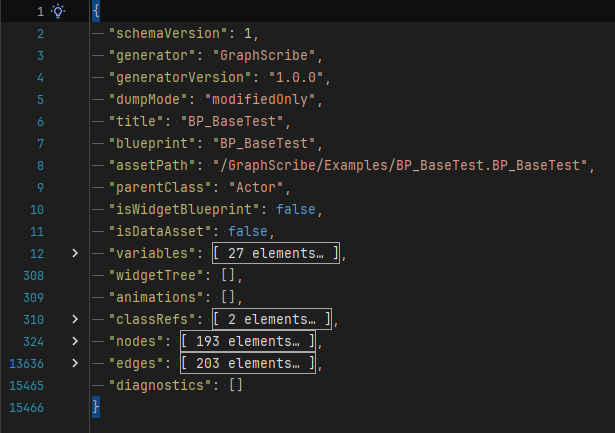
JSON document shape
Section titled “JSON document shape”Root fields of an EmitJson document (see JSON Output for examples):
title, blueprint, assetPath, parentClass, isWidgetBlueprint, isDataAsset, variables[],
widgetTree[], animations[], classRefs[], nodes[] (each with pins[]), edges[], diagnostics[].
Graphify document shape
Section titled “Graphify document shape”Nodes (nodes[]):
| Field | Meaning |
|---|---|
id | Stable id to bp: / fn: / evt: / cls: for linkage, var_... for variable rows, widget_N for widget-tree rows |
label | Display label (truncated for long variable values) |
file_type | Always "code" |
source_file | Asset path the node came from |
source_location | Optional e.g. "Variables", "ClassRefHard", "Linkage" |
origin / hasChildren / category / declaringClass | Optional variable-row metadata |
kind / nativeFunction | Optional on evt: nodes, kind: "event" and the raw engine function name (e.g. "ReceiveBeginPlay") |
Edges (edges[]): source, target, relation, confidence (always "EXTRACTED"), source_file.
The Graphify stability contract
Section titled “The Graphify stability contract”The most important guarantees for tooling:
1. IDs are stable across exports
Section titled “1. IDs are stable across exports”bp:<AssetPath>a Blueprint or DataAssetfn:<AssetPath>::<FunctionName>a function inside an assetevt:<AssetPath>::<EventName>a native engine event (display name, e.g.BeginPlay. The raw engine function is carried innativeFunction). Schema v2 made native events first-class callables.cls:<ClassPath>a class reference
These are derived from asset/class identity, not from node GUIDs or graph layout. A consumer can persist an ID and re-resolve it after a re-export.
2. Relations are a closed set
Section titled “2. Relations are a closed set”The merge step only understands these relations: calls, defines, uses. Per-asset Graphify may
also emit contains for local structure (widget tree / variable nesting), the merge drops it. Events and
functions are both callables: calls edges connect them (evt: → fn:, cross-asset, and super-calls). If a new
relation is ever added to the merge, that’s a schema bump.
3. Merge is forward-compatible
Section titled “3. Merge is forward-compatible”MergeGraphifyLinkage / MergeGraphifyLinkageFromDirectory:
- skip malformed or empty inputs,
- deduplicate stable nodes (first one wins),
- deduplicate identical
source|relation|targetedges, - drop edges whose endpoints aren’t stable IDs,
- pass through unknown object fields.
So adding optional fields does not break older consumers. The batch merge re-reads every *.graphify.json under
the output directory (skipping ProjectLinkage.graphify.json itself), so folder-by-folder exports accumulate.
4. Diagnostics use one shape
Section titled “4. Diagnostics use one shape”Documents carry a "diagnostics" array only. There is no legacy "warnings" string array. See
Diagnostics Codes.
When to bump schemaVersion
Section titled “When to bump schemaVersion”Bump the relevant schemaVersion (and document it in the changelog) when a change is not backward-compatible
for a consumer that already parses the current shape:
- Renaming or removing a required field from
nodes/edges/ variables. - Changing the meaning of an existing field (e.g. what
idpoints at). - Adding a new
relationto the Graphify merge closed set. - Changing the Graphify ID grammar (
bp:/fn:/evt:/cls:prefixes or the::separator).
Do not bump for:
- Adding an optional field consumers can ignore (forward-compatible).
- Markdown/Mermaid wording changes.
- Bug fixes that make output match the documented shape.
- Adding a new diagnostic
code(consumers must ignore unknown codes).
generatorVersion follows the plugin’s semver and may move independently of schemaVersion. A schema bump should
also be called out in the changelog under the release that introduced it.