
Ways to Export
There are four ways to export with GraphScribe. Start with whichever matches what you’re doing.
1. Export a single asset
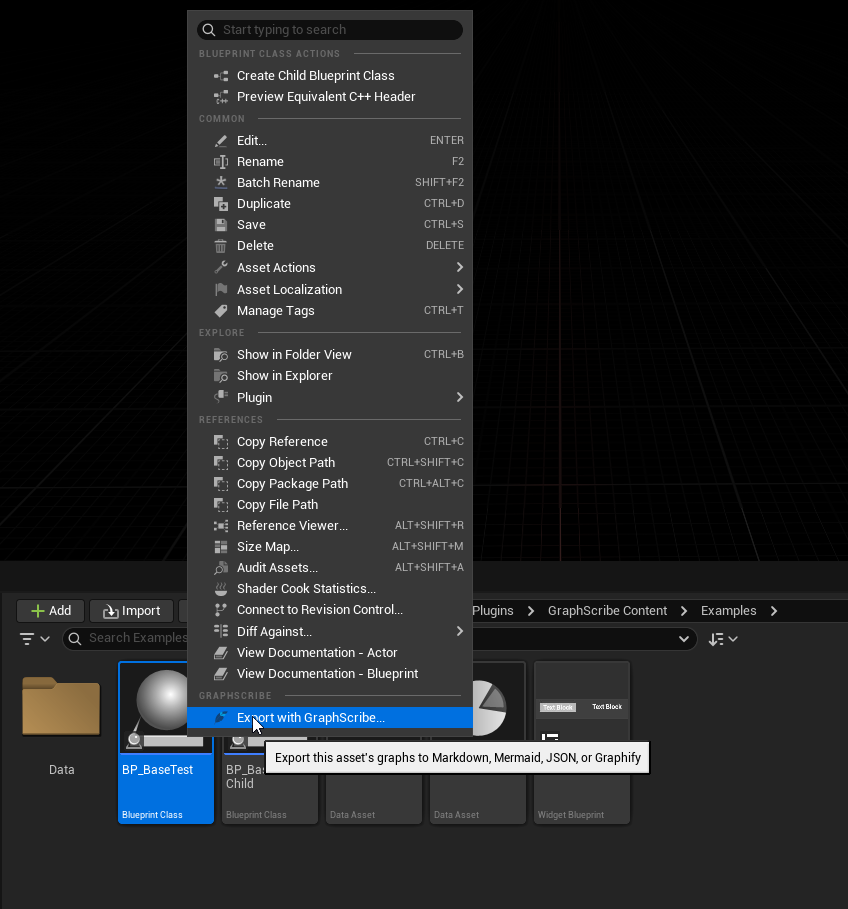
Section titled “1. Export a single asset”- Open a Blueprint or Widget Blueprint → click GraphScribe in the toolbar → the export dialog opens with a live preview → Copy or Save As….
- DataAssets don’t have a Blueprint toolbar: right-click the asset in the Content Browser → Export with GraphScribe….
- Works on Blueprints, Widget Blueprints, and DataAssets.
2. Export selected nodes only
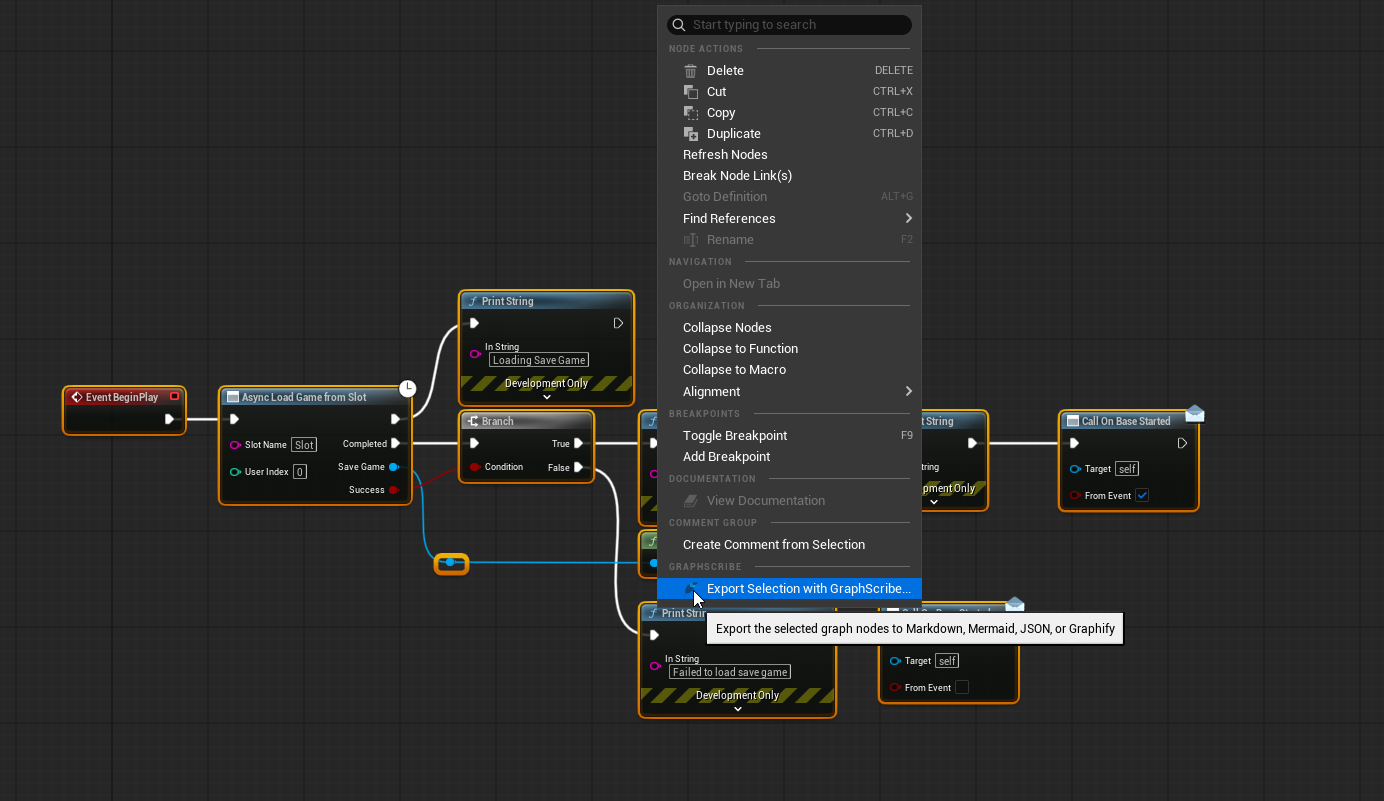
Section titled “2. Export selected nodes only”Sometimes you only want part of a graph, a snippet for a PR, a doc, or a question.
- Select some nodes inside a graph.
- Right-click → Export Selection with GraphScribe…
Snippet exports are smaller and focused:
- they include the selected nodes plus the owning function’s entry,
- collapsed composite nodes expand to include their inner graph nodes,
- they intentionally omit variables, widget trees, and class references.
3. Export a whole folder
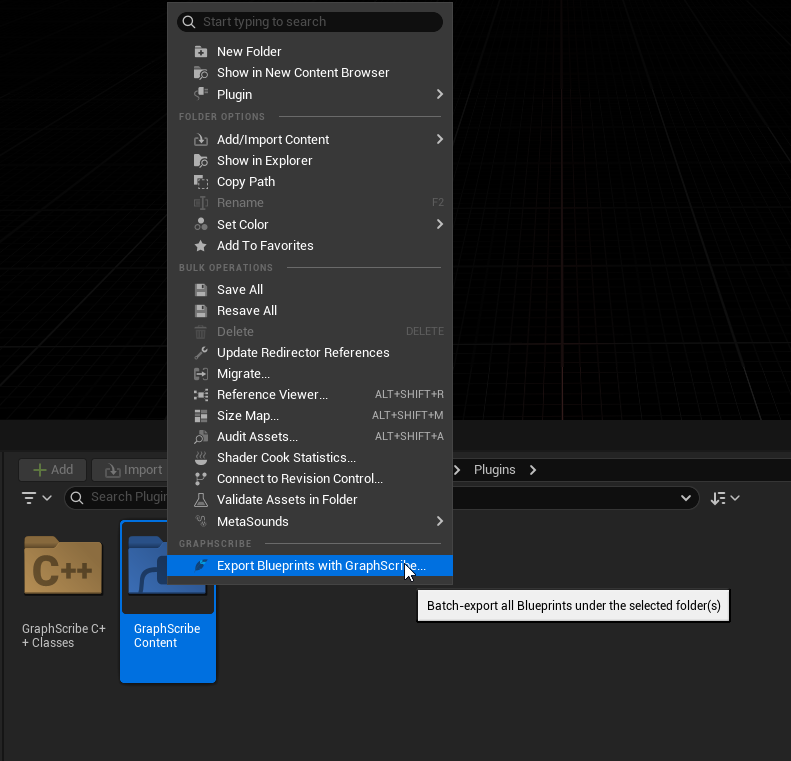
Section titled “3. Export a whole folder”This is the option for documenting a feature or your whole project, and the mode you’ll use most with AI tooling.
- In the Content Browser, right-click one or more folders → Export Blueprints with GraphScribe….
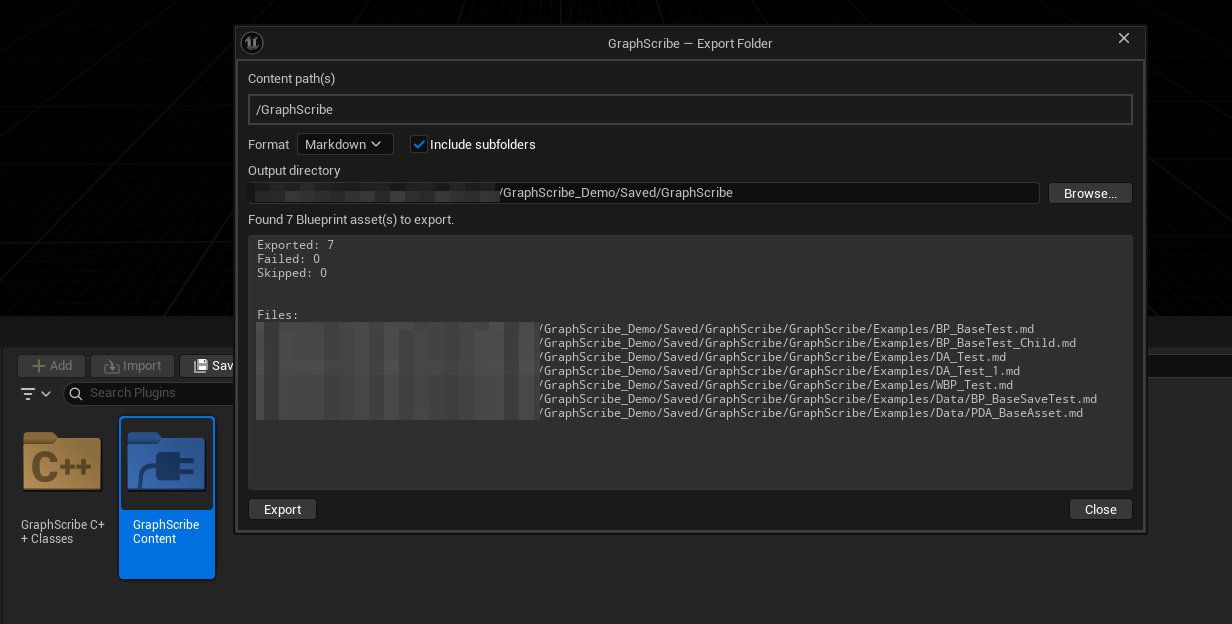
- A batch dialog (GraphScribe Export Folder) opens showing:
- the selected content path(s),
- the Format combo: Markdown, Graphify, Mermaid, JSON, or Obsidian (batch-only),
- an Include subfolders checkbox (on by default),
- a live count, Found N Blueprint asset(s) to export,
- the Output directory (pre-filled with your configured save directory) with a Browse… button.
- Click Export. GraphScribe exports every supported asset with the selected format and writes a log
(
Exported:/Failed:/Skipped:counts, skipped assets, and every written file) plus a toast notification.
Notes:
- Output files mirror your Content structure under a per-format subfolder:
/Game/Foo/Bar.BP_X→<Output Directory>/<Format>/Foo/Bar/BP_X.<ext>(e.g.Markdown/,Mermaid/,JSON/,Graphify/,Obsidian/). Exports of different formats never mix. - DataTables are never gathered, Blueprints that can’t be exported (e.g. interface/macro-only assets) are listed under Skipped.
- If you chose Graphify, the run also rebuilds
ProjectLinkage.graphify.jsonat the root of theGraphify/subfolder, a single project-wide graph merged from every*.graphify.jsonalready under that folder (so folder-by-folder exports accumulate). It also writes the graphify-readyGraphify/graphify-out/graph.jsonwrapper, and with Generate Graphify Viewer on (off by default), it will auto-runsgraphify cluster-onlyin the background to produce the interactivegraph.htmlviewer, with an Open Graphify Viewer button in the dialog. See Graphify: AI-Ready Graphs and Graphify: Install & Use. - If you chose Obsidian, the run writes a complete vault under
Obsidian/. Actor notes, function/event/macro sub-notes, graph overview notes, class notes, per-asset Canvas files, plus a vaultDashboard.mdandREADME.md. Obsidian is available only in the batch dialog. See Obsidian Vaults.
Where do files go?
Section titled “Where do files go?”- Single asset: you choose the location in the Save As… dialog, pre-filled with the directory configured in Project Settings.
- Folder batch: the Output directory field in the batch dialog (pre-filled from the same setting).
- Selection: same as single asset.